


Structural frustration, metastability and cascade of polar phases in a layered lead bromide perovskite
Title: Structural frustration, metastability and cascade of polar phases in a layered lead bromide perovskite
Authors: M. Mączka*, K. Fedoruk-Piskorska, A. Gągor, J.K. Zaręba, D. Stefańska, M. Ptak, D. Drozdowski, A. Sieradzki
Journal: Chemical Science
DOI: 10.1039/D5SC09693F
In their latest article, Prof. Mączka and co-workers describe the discovery of a remarkable phenomenon of kinetic phase stabilization in the layered hybrid perovskite CPA2PbBr4 (CPA = 3-chloropropylammonium). It was observed that relatively slow cooling (3 K/min) leads to the formation of a metastable polar phase (Phase IV, Pna21) instead of the thermodynamic ground state, which can be reached when the cooling rate drops to 1K/min. The compound exhibits three non-centrosymmetric polar phases below 350 K, differing in the orientation of CPA+ cations and the distortion of PbBr6 octahedra, which results in a tunable dielectric response and nonlinear optical activity manifested by second-harmonic generation (SHG). It was also reported that cyclic temperature variations suppress the SHG intensity without any accompanying structural changes. This phenomenon was attributed to strain limiting the coherence length. Furthermore, the compound displays efficient broadband photoluminescence with pronounced thermochromism originating from self-trapped exciton states. Pyroelectric measurements confirmed spontaneous polarization in the range of 1.2–2.2 μC/cm² across all polar phases.
In summary, Prof. Mączka’s work highlights the importance of kinetics in controlling structural order/disorder and distortion, and thus the physicochemical properties of hybrid perovskites. Kinetic control of phase selection is therefore an effective strategy for modulating polar order and functional properties in hybrid perovskites, with potential applications in optoelectronics and photonics. This discovery is also of great importance for the whole scientific community since is shows that kinetic trapping can be achieved even under relatively slow cooling rate, commonly employed for monitoring LT phases of hybrid, organic and inorganic compounds in X-ray diffraction, optical and spectroscopic measurements. Therefore, these findings underscore the critical importance of carefully controlling the cooling rate in such studies, especially when a perovskite undergoes a LT PT associated with very large thermal hysteresis.
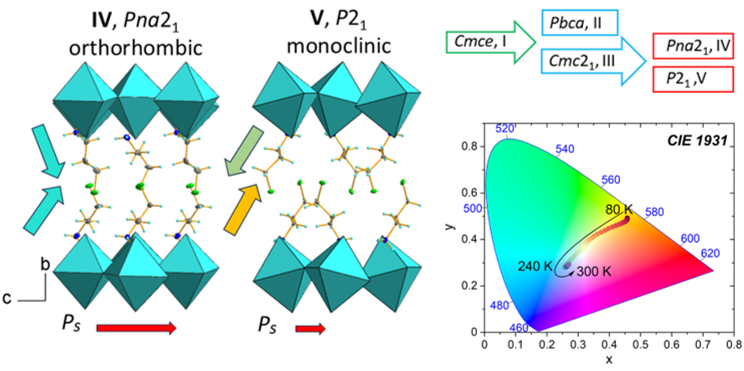
Highlights:
- Discovery of kinetic phase stabilization in the layered hybrid perovskite CPA₂PbBr₄, where relatively slow cooling induces a metastable polar phase instead of the thermodynamic ground state.
- Identification of three non-centrosymmetric polar phases below 350 K, exhibiting distinct cation arrangements and octahedral distortions that enable tunable dielectric and nonlinear optical properties.
- Observation of reversible SHG modulation, with thermal cycling suppressing SHG intensity without structural phase changes, attributed to strain-limited coherence length.
- Efficient broadband photoluminescence with strong thermochromism, arising from self-trapped exciton (STE) states and highlighting the material’s optoelectronic potential.
- Confirmation of spontaneous polarization (1.2–2.2 μC/cm2) in all polar phases, demonstrating robust ferroelectric-like behavior and opportunities for photonic and optoelectronic applications.
