


Emergence of a Relaxor Phase and Dimensional Tuning in Mixed 2D Hybrid Perovskites
Title: Emergence of a Relaxor Phase and Dimensional Tuning in Mixed 2D Hybrid Perovskites
Authors: G. Rimkus, S. Balčiu̅nas, A. Gągor, D. Szewczyk, K. Fedoruk-Piskorska, J. K. Zarȩba, A. Sieradzki, V. Klimavičius, J. Banys, M. Mączka, M. Šimėnas
Journal: Chemistry of Materials
DOI: 10.1021/acs.chemmater.6c00851
The most current outcomes of Prof. Mączka’s collaboration are presented in this publication. A large team has been working to understand the effect of cation mixing in the perovskite cages on structural, optical and electrical properties in multilayered perovskites. Multilayered perovskites comprising large spacer cations and small cage cations are rapidly evolving materials with diverse optoelectronic applications. The research focused on Ruddlesden-Popper A′2An‑1PbnX3n+1 (n≥ 2) analogues, where A denotes a small “perovskitizer” cation (in this case methylammonium (MA) or dimethylammonium (DMA)), A′ is a large monovalent spacer cation (in our case butylammonium, BA) and n denotes number of octahedral layers.
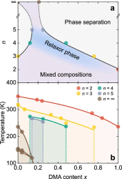
It has been demonstrated using X-ray diffraction, DSC, second harmonic generation (SHG) and dielectric spectroscopy that substituting MA with dimethylammonium DMA in the perovskite cages of BA′2An‑1PbnBr3n+1 leads to lowering of the ferroelectric phase transition temperature. Most importantly, this substitution transforms the long-range ferroelectric phase into a state characterized by frustrated electric dipoles. Broadband dielectric measurements reveal that this state is a relaxor phase, which was previously unobserved in hybrid perovskites. Remarkably, cation mixing also governs perovskite dimensionality, enabling stabilization of thick-slab members up to n = 5 in single-crystal form. Furthermore, this work shows that doping with DMA (increase of n) leads to widening (narrowing) of the band gap. In summary, these results establish cation mixing as a versatile tool for controlling polar order, dimensionality and band gap in multilayered hybrid perovskites.
Highlights:
- Discovery that doping of MA in BA′2MAn‑1PbnBr3n+1 with DMA (increase of n) leads to widening (narrowing) of the band gap.
- Discovery that this doping stabilizes thick-slab members up to n = 5.
- Discovery that the mixed-cation systems are the first examples of relaxor ferroelectrics among hybrid perovskites.
