

Analytical framework for high-precision cryogenic thermometry: Characterization of RhFe and PtCo sensors below 25 K
Title: Analytical framework for high-precision cryogenic thermometry: Characterization of RhFe and PtCo sensors below 25 Ky
Authors: G. Szklarz*, R. Nikonkov, A. Kowal
Journal: Measurement
DOI: 10.1016/j.measurement.2026.121409
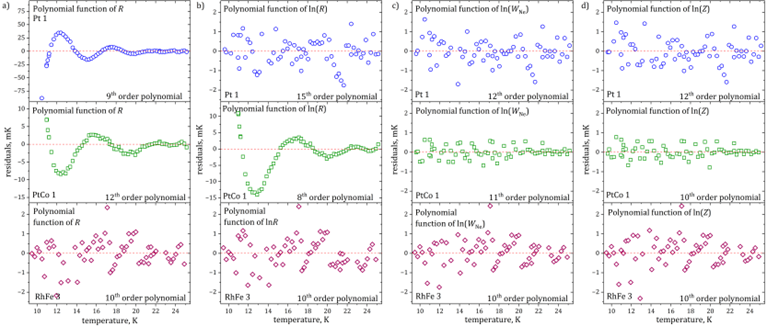
In cryogenic thermometry, precision reaching sub-mK levels is critical. To achieve such accuracy, thermometers based on rhodium-iron (RhFe) and platinum-cobalt (PtCo) alloys are employed. While these sensors exhibit excellent metrological parameters and high sensitivity at the lowest temperatures, their accuracy is often limited by the challenges of determining an optimal calibration function. The pronounced non-linearity of these sensors' characteristics makes their precise description using traditional polynomials problematic and prone to systematic errors.
To address this issue, we have developed a Python-based analytical framework that not only automates the calibration function optimization process but also detects outliers and performs a rigorous statistical evaluation of the models. A key innovation of this tool is the shift from simple goodness-of-fit criteria toward advanced diagnostics, including information criteria (AIC/BIC) and the Durbin-Watson test. This approach guarantees the physical consistency of the resulting models and effectively mitigates the phenomenon of overfitting.
To verify the effectiveness of the developed tool, measurements were conducted on 17 sensors (including Pt, PtCo, and RhFe types) for calibration below 25 K. The results demonstrated that rational functions represent the superior class of functions for describing the characteristics of RhFe and PtCo alloy thermometers. In contrast to commonly used high-degree polynomials, rational functions exhibit significantly higher numerical stability, minimizing the risk of oscillations (Runge's phenomenon) and more accurately capturing the physical changes in sensor sensitivity. This approach not only allows for a substantial reduction in residuals but also paves the way for the creation of a universal calibration function for RhFe and PtCo thermometers, covering a wide temperature range – from the boiling point of helium to the triple point of water.