


Three-Dimensional Hybrid Perovskitoid Single Crystals Constructed with Di- and Monoammonium Cations for Light- Emission and Photodetection
Title: Three-Dimensional Hybrid Perovskitoid Single Crystals Constructed with Di- and Monoammonium Cations for Light- Emission and Photodetection
Authors: M. Mączka*, D. Drozdowski, D. Stefańska, B. Popanda, V. Anilkumar, D. Prochowicz
Journal: Chemistry of Materials
DOI: 10.1021/acs.chemmater.6c01171
Hybrid lead halide perovskitoids with extended 3D connection modes have attracted a lot of attention for optoelectronic and photodetection applications, but up to now,
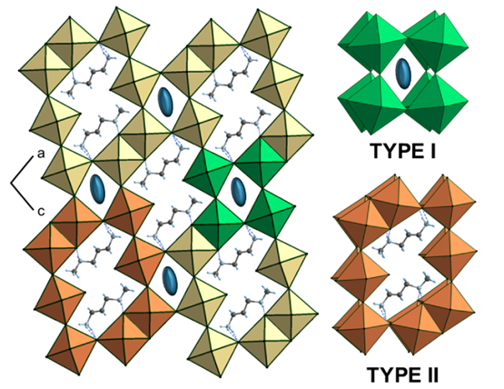
only one example comprising divalent and monovalent cations is known, i.e., MPDA2FAPb4Br13 (MPDA = N-methylpropanediammonium, FA = formamidinium). In this article, Prof. Mączka with co-workers and collaborators from the Institute of Physical Chemistry PAS, reports the synthesis of three new analogues with formula MPDA2APb4Br13 (A= methylammonium (MA), ethylammonium (EA), or dimethylammonium (DMA)). Structural and optical investigations revealed that all compounds crystallize in the monoclinic P2/m space group and exhibit both narrowband and broadband photoluminescence accompanied by pronounced thermochromism. The authors demonstrated that the intensity of the broadband emission increases with increasing octahedral distortion, establishing a structure-property relationship. Furthermore, a single-crystal photodetector fabricated from MPDA2MAPb4Br13 operates at a remarkably low bias voltage of only 0.5 V while maintaining stable photocurrent over repeated illumination cycles, demonstrating excellent device reliability.
In summary, Prof. Mączka’s work expands the very small family of mixed-cation 3D hybrid perovskitoids by three new members and shows for the first time that the relaxed Goldschmidt tolerance rule is valid not only for 2D perovskites but also for 3D perovskitoids. It also demonstrates tunable optical properties, and strong potential for light-emitting and low-power photodetection applications.
Highlights:
- Synthesis of three new mixed-cation hybrid lead bromide 3D perovskitoids incorporating MA, EA, and DMA cations, adopting monoclinic P2/m symmetry, isostructural to known formamidinium based analog.
- Establishment of a structure-property correlation between broadband photoluminescence intensity and the degree of intraoctahedral distortion, particularly of corner-sharing PbBr6 octahedra.
- Fabrication of a single-crystal MPDA2MAPb4Br13 photodetector operating at a low bias voltage of 0.5 V while maintaining stable photocurrent during repeated operation.
