

Ce(III) formate-derived hierarchical cerium oxide particles with icosahedral symmetry-based architectures: Effect of third level of structural hierarchy in soot and propane oxidation
Title: Ce(III) formate-derived hierarchical cerium oxide particles with icosahedral symmetry-based architectures: Effect of third level of structural hierarchy in soot and propane oxidation
Author: P. Woźniak
Journal: Acta Materialia
DOI: 10.1016/j.actamat.2024.120372
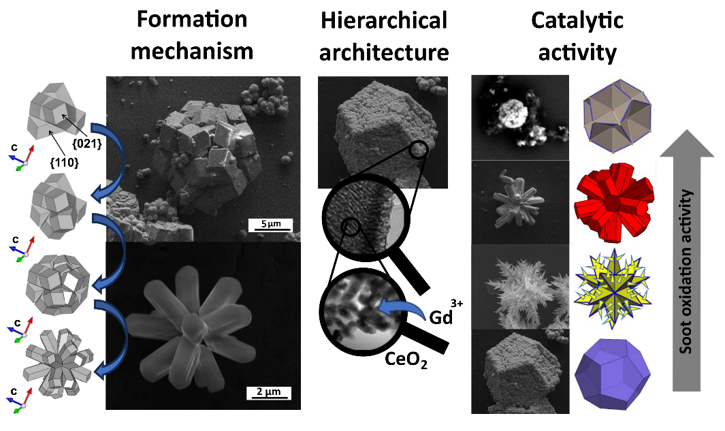
The article investigates the role of architecture of complex hierarchically structured ceria and gadolinium doped ceria particles in soot combustion (solid-solid reaction) and propane oxidation (gas-solid reaction). Careful choice of parameters of solvothermal synthesis (composition of reaction mixture, temperature, time) allows to obtain particles with given icosahedral symmetry-based architectures, i.e., dodecahedron-like, concave dodecahedron-like, rhombic hexecontahedron, various stellated polyhedra including great stellated dodecahedron and fractal-like branched great stellated dodecahedron, great dodecahemicosacron. Twinning-based multiple branching of Ce(III) formate crystals by {101} twin orientation relation was proposed as a driving mechanism for the formation of macroparticles architecture that has been confirmed by the construction of macroparticle models using the identified twinning law.
In the catalytic studies, the third level of the material organizational structure referring to shape of hierarchical macroparticles was chosen as a tested variable, while other architecture-related properties were controlled to be alike. In result, the shape of hierarchical particles plays a vital role in the catalytic soot oxidation, and architecture modulation allows the catalytic properties of the material to be enhanced through increasing the geometrical fit between ceria and soot particles. The best sample lowers temperature of half oxidation by 143 ℃ as compared to non-hierarchically organized ceria nanocrystals. The shape of hierarchical particles does not play leading role in gas-solid propane oxidation, but introduction of Gd dopant diversifies catalytic activity. The architecture of the particles may serve as a modifier of the catalytic activity through grain boundary engineering of gadolinium doped ceria.