

An experimentally informed model of meso‑scale architecture of CeO2 hierarchical catalyst: the role of structural hierarchy of Ru-decorated Co-doped CeO2 in propane oxidation
Title: An experimentally informed model of meso‑scale architecture of CeO2 hierarchical catalyst: the role of structural hierarchy of Ru-decorated Co-doped CeO2 in propane oxidation
Authors: P. Woźniak*
Journal: Acta Materialia
DOI: 10.1016/j.actamat.2026.122721
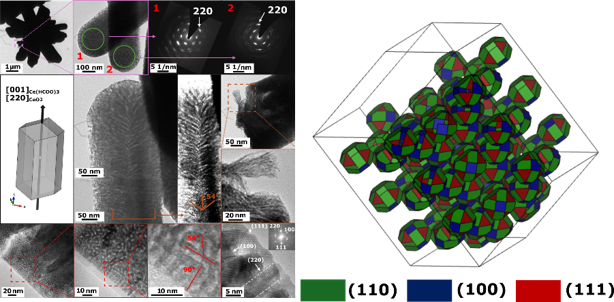
hierarchical catalyst has been presented. Data from TEM, HRTEM, SEM, SAED, and ET were used to inform the construction of model of texture of hierarchically structured CeO2 particle via crystallographic modelling approach. The model allowed to explain the exceptional activity of Ru/CeO2 hierarchically structured catalyst (T50= 130°C, Ea = 33 kJ/mol), and its enhanced regeneration potential.
While the architecture of CeO2 catalyst is imprinted in the crystallographic structure of the Ce(HCOO)3 catalyst precursor, the driving principle for texture formation is geometric fitting of ceria crystallites along the directions of similarity of structural motifs of both materials. Structural elements dissimilarity is behind formation of channels that allow rapid diffusion of gaseous thermolysis products that leads to development of highly porous catalyst that exposes (110) CeO2 facets inside the porous volume, which poses compromise between activity and stability.
Doping hierarchical ceria by cobalt ions changes the architecture and increases activity of the catalyst but decline of activity is seen when specific texture is lost for highly doped samples. Structural hierarchy facilitates regeneration of Ru-decorated CeO2 system due to fostering redispersion of Ru inside the porous volume of macroparticle during variable conditions of catalytic process. The presented approach for synthesis and modelling of hierarchically structured oxide catalyst opens possibility of knowledgeable design of materials showing synergistic properties.